As I've been sooooooo inundated with work lately, I haven't been updating my blog for a couple of weeks! The thing is, Master
has been caught up with publishing jobs for a client, and all the
restoration works have been on my shoulders.. Anyway, for the last
couple of days, I had been working on the most famous book of Sir. Thomas Browne's, Pseudodoxia Epidemica or Enquries into very many received Tenents and commonly presumed Truths, together with the Religio Medici,
published in 1672. (The sixth and the last edition) Well, first of all, this book has
been "restored" previously, and the person obviously didn't know what he
was doing... He used bookcloth/cloth to attempt re-hinging, (and patched a piece of unmatched leather over it superficially to cover it up.) and inevitably
failed. (The picture on the right.) I think I've mentioned how frustrating it is to fix someone
else's jobs sometime ago, and this wasn't an exception. One crucial
issue I had regarding the restoration of this book was that it was
impossible to remove the previous "re-hinge" material (which was glued
underneath the leather on the boards), without damaging the original
leather. Thus, I had to leave it alone, and had to do a rehinge with the
initial material still attached to the leather.. You see, it's like a
medical doctor couldn't take out a bullet from your brain because it
would result in damaging you even more, and you'll have to live with the
darn thing in the head for the rest of your life! So, people, if you
wanna fix your book by yourself, you gotta consult with a bookbinder,
yeah? Anyway, in terms of restoration of this book, it needed a re-hinge
with leather that I custom dyed to match the original, the edges and
corners of the boards reconstructed, and because it was missing
headbands, I did a quick set of one core headbands sewn. The client asked me
to design the spine to be suited for the era of the binding, so I did a
red, antiqued leather skiver and raised bands with blind band ornaments, just like the
original. Oh, by the way, this book had a book plate with an engraving
by William Hogarth, so I took a picture of it. (By the way, the engraving and the quote on the bookplate "I have several of the best books, though some of them are a little torn." are from Henry Fielding's Tom Jones, Chapter 8. ) Thursday, May 17, 2012
Pseudodoxia Epidemica, 1672
As I've been sooooooo inundated with work lately, I haven't been updating my blog for a couple of weeks! The thing is, Master
has been caught up with publishing jobs for a client, and all the
restoration works have been on my shoulders.. Anyway, for the last
couple of days, I had been working on the most famous book of Sir. Thomas Browne's, Pseudodoxia Epidemica or Enquries into very many received Tenents and commonly presumed Truths, together with the Religio Medici,
published in 1672. (The sixth and the last edition) Well, first of all, this book has
been "restored" previously, and the person obviously didn't know what he
was doing... He used bookcloth/cloth to attempt re-hinging, (and patched a piece of unmatched leather over it superficially to cover it up.) and inevitably
failed. (The picture on the right.) I think I've mentioned how frustrating it is to fix someone
else's jobs sometime ago, and this wasn't an exception. One crucial
issue I had regarding the restoration of this book was that it was
impossible to remove the previous "re-hinge" material (which was glued
underneath the leather on the boards), without damaging the original
leather. Thus, I had to leave it alone, and had to do a rehinge with the
initial material still attached to the leather.. You see, it's like a
medical doctor couldn't take out a bullet from your brain because it
would result in damaging you even more, and you'll have to live with the
darn thing in the head for the rest of your life! So, people, if you
wanna fix your book by yourself, you gotta consult with a bookbinder,
yeah? Anyway, in terms of restoration of this book, it needed a re-hinge
with leather that I custom dyed to match the original, the edges and
corners of the boards reconstructed, and because it was missing
headbands, I did a quick set of one core headbands sewn. The client asked me
to design the spine to be suited for the era of the binding, so I did a
red, antiqued leather skiver and raised bands with blind band ornaments, just like the
original. Oh, by the way, this book had a book plate with an engraving
by William Hogarth, so I took a picture of it. (By the way, the engraving and the quote on the bookplate "I have several of the best books, though some of them are a little torn." are from Henry Fielding's Tom Jones, Chapter 8. ) Thursday, May 3, 2012
Northfield High School Yearbook, 1927
School yearbooks are something that I really don't wanna open, unless someone asks me for a good laugh. You know, there's always someone whose picture makes you think, like, "WTF !?!" or " Damn,, it must suck to be you.." sorta thing, and my yearbook pictures definitely belong to the category. I have an unusually thick and tough hair for an Asian and when I was a kid, I really didn't take care of it so well. And because my mom kept it short throughout my childhood, my hair always looked like a mad scientist's after his lab got exploded. - The ultimate bad-hair-years was what it was. So, whenever we get yearbook restoration jobs here, I habitually look through the pages, looking for someone with whom I can commiserate! Anyway, aside from my bad habit of cynically checking out the photos, it's always interesting to see the styles and fashions of each era. This yearbook was published in 1927 for Northfield High School in Minnesota. People in there are all looking fabulous.. (I couldn't find a single "WTF!" picture.. Damn it! And for your information, people were all fit back then... Pre-fast food era....) Anyway, in terms of restoration, the client wanted a brand new leather case with the original front cover inlay-ed, and the book needed to be re-sewn. It was a simple job.
Friday, April 20, 2012
Self-Help by Samuel Smiles, 1897
You
know a guy named Bear Grylls, who eats bugs and dirt in the wilderness to
survive? (yuck... am shivering.. brrrrr...) Looks like his
great-great-grandfather was a bit of a public figure himself. He, Samuel
Smiles authored a bunch of books but his most famous book was Self-Help. Well, growing up in the middle of the
Industrial Revolution, and being in a family of Cameronian, I kinda see why he
wrote a book like this. (Just to remind you that I have neither political nor
religious affiliations what-so-ever. I just happened to take before-after
pictures of this book and it's such a pretty binding, so I featured it here.)
Anyway, this is one of the earlier editions of Self-Help with illustrations
of conduct and perseverance, published by John Murray in 1897. (Popular
Edition, Third print) In terms of restoration, it just required an external and
internal re-hinging. As you might know, some books have first and last
signatures sewn in a stab manner, and those stab sewn signatures have tendency
to get broken as the thread creates too much stress on the pages, as you can
imagine. I don't like stab sewn books mainly because of that. (The other reason
is because stab sewn signatures don't open flat.) I took a picture of the fate
of stab sewn signatures, so that you can see it yourself. I know stab sewing seems to be popular amongst
bookbinding hobbyists, but be aware! They won't last long. You might say, "But
the traditional Japanese books are stab sewn, and last hundreds of years!" Well,
the paper they used is different. They used a paper that is extremely flexible
and has no grain, thus it could withstand the stress created by the thread.
(But of course, the thread gets broken because of the stress like any other stab bindings.) Anyhow, if you want your book to last long, just sew it by the European method.
:-) Oh, by the way, I was just gonna use a bookcloth for the internal hinge, but
somehow, I took a trouble to use leather.. Hummm, I think I had one too many
beers that night. The thing is, leather's better, so the client got a better
deal!Friday, April 13, 2012
Yapp Bible

I'm finally finishing up the last two books from Chet Ross Rare Books, and they'll be complete tonight. The main reason why I've gotten behind on finishing these books is because of my masterrr! He gave me a couple of Bibles that needed to be done in a couple of days... Anyway, this is one of the Bibles. I forgot to check the publisher and the date of this Bible, but I took some pictures of the process of a partial re-sewing. I'd assume that the complete re-sewing is a no brainier to most people, but I thought some people might wonder how bookbinders re-sew a partially broken signatures without completely breaking down the book. This is one of the methods of re-sewing the parts of broken signatures. Basically, what's shown here is to connect the original thread to a new one, and sew the broken signatures together. Anyway, the owner of this Bible wanted a facsimile case, but didn't want to spend money on leather. So the cover material is a black imitation leather buckram with a flap on the edges. (Yapp binding)
Friday, April 6, 2012
British and Irish Salmonidae, 1887

Hummm, I thought this book might be of interest to some readers of my blog, so I decided to post it. You see, this is an example of a "restoration" gone wrong. Someone, hopefully not a person who makes a living as a conservation bookbinder, tried to "patch up" damaged parts of this cloth binding. Indeed, we sometimes get clients asking us to do very minimum minor restoration on their books, and often what they ask us to do is basically to "patch-it-up". I, personally, don't like those sort of jobs because I know they aren't perfectly fixed and most of the time, it's a tricky job to perform. HOWEVER, those patched-up parts shouldn't be the first parts to be broken or get damaged again as the years go by. You know what I mean? OK, take a look at this book. Normally, the top and bottom spine of a book get damaged even if everything else is still fairly intact, like this book here. So someone tried to "fix" the spine, as you see. The method/approach of which he/she attempted was not totally far off in terms of "patching up the fragments",by any means, yet the integrity of the repairs were incredibly loose (literally) and the craftsmanship was absolutely sloppy, resulting in the parts to have fallen apart too prematurely and damaged the original even more. As a conservation bookbinder, I'm always very nervous and on edge when handling a work because the fate of the book is totally in my hands.- I'm not allowed to make mistakes, let alone damage the book because of me. Anyway, in case I sound like I'm being arrogant by pointing faults of someone else's work here, I just want to clarify that I'm not saying I'm better than other binders. (Absolutely no way! I'm FAR from perfect!!! I'm an amateur compared to the masters in the world!!) What I want to tell you here is to be careful which bookbinder you're gonna ask to restore your precious books. And if you aren't a bookbinder, but wanna fix a book by yourself, no matter how minute the task might look to be, you should consult a bookbinder whose reputation is solid.----------------------------------------------
Mr. Ross, in case you are reading my blog, I'd like to inform you that it'll be another couple of days till I finish all of your books. - I have two more books to go. I apologize for the delay. I'm a horrible multitask-er, so I can't work on more than one book at a time. We'll e-mail you when they are actually done. Thank you for your patience.
Tuesday, April 3, 2012
Cherry Blossom
The owner and his wife of Newberry Books gave us a bunch of cherry blossom branches a couple of days ago, and now they are fully blossoming! Spring has come to the bindery! It reminds me of my parents house which is located by a stream with a long row of cherry blossom trees. I don't think they are in season yet as I heard that they had an extremely cold winter there.
Saturday, March 31, 2012
Lt. Danenhower's Narrative of the Jeannette, 1882
Another book from Chet Ross Rare Books here is Lieutenant Danenhower's Narrative of the Jeannette, published by J. R. Osgood & Co. in 1882. (First Edition) It was a half binding with black leather spine and marble paper boards, and it basically just needed rehinging. But, Mr. Ross wanted corners added and the leather to be brown instead of the black as the original. I think brown was a good choice for this book. It feels more "just right" with brown, of which color also enabled me to antique it slightly on the surface. (If it were black, I wouldn't have been able to do so, and the leather would have appeared too new, compared to the beautifully aged marble paper.) This is a thin book, so stamping the title was tricky - I'm glad that our smallest micro type fitted on the narrow spine!! OR I'd have to stamp it vertically, which would be less attractive, to say the least. Anyway, I thought somehow, Lt. Danenhower's goggles are strangely modern looking and are cool to me. So, I took a picture of his frontispiece portrait. (He had an inflammation issue with one eye, so one of the goggle glasses is stained?) Oh, by the way, based on the library label, this particular book was one of the very first books to be collected by The Ames Free Library in Massachusetts, considering the library was officially opened in 1883. (This book was acquired on October 11th, 1882. Shelf No. 326,14. Accession No. 6875.)Thursday, March 29, 2012
A Dutch Arctic Expedition and Route, 1877
Whenever I finish a job, I always ask my master if there are any
rush jobs that need to be done immediately. Master's mind is normally
too preoccupied with what's in front of him so that he forgets things
occasionally. After I completed Mr. K's books, I asked him if there was
anything he wanted me to work on, as a habit, not really expecting he
had anything. Boy, how wrong I was. He gave me 14 books from Chet Ross Rare Books
to work on. 14 books, yo! and I have a week or so to complete most of
them. Thanks A LOT!!! Fortunately, Mr. Ross's inquiries are usually for
minor restoration/repairs, so I've finished four of them already. Since
the books I've so far finished involved minor repairs like mending the
internal hinge, paper repair and fixing bubbles on the boards, I didn't
record them for my blog. But I thought this one I just finished might be
an interest to some people (after mentioning "reconstruction"
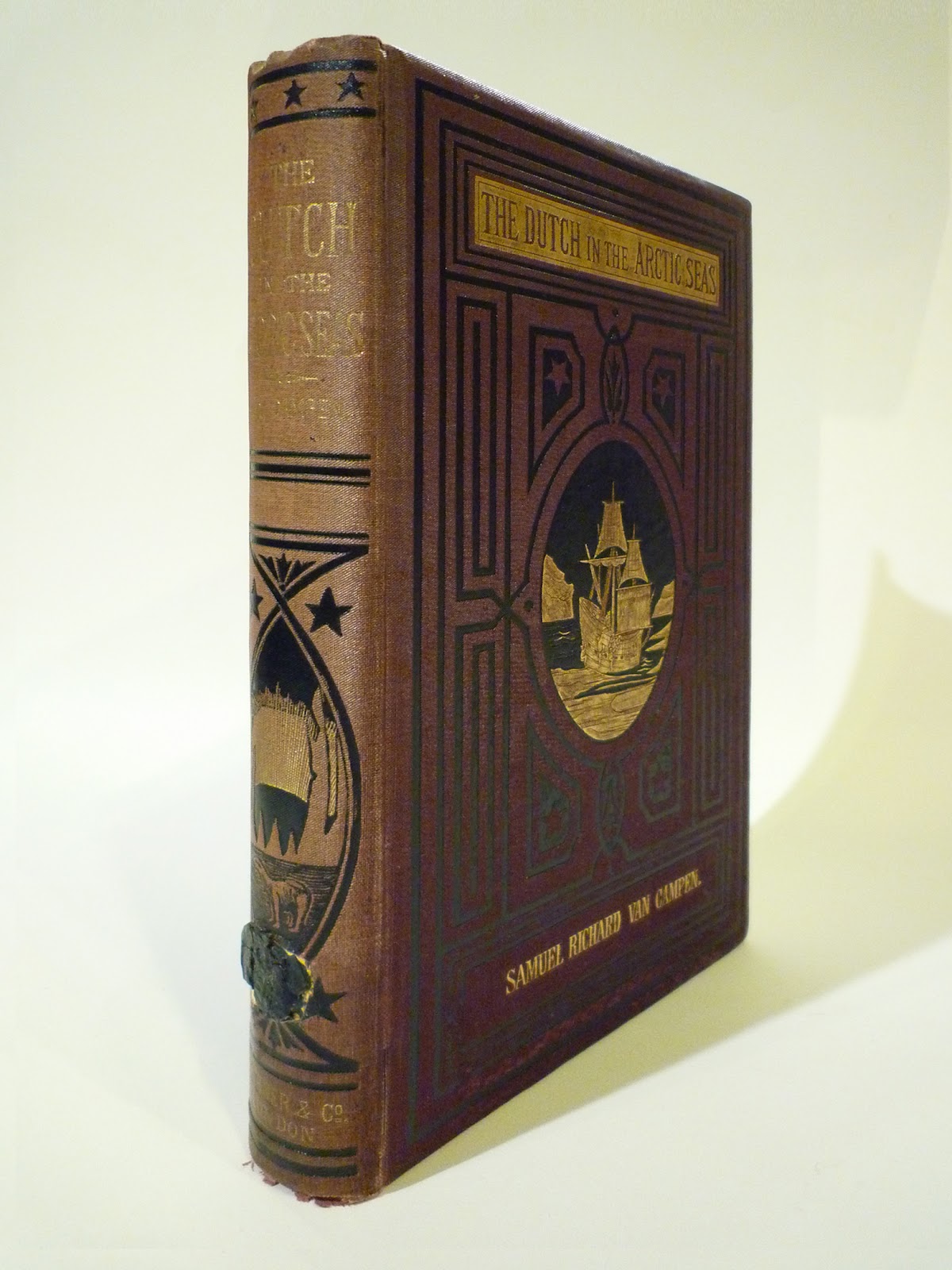
previously), so I took some pictures of the process briefly. This is A Dutch Arctic Expedition and Route
by Samuel Richard Van Campen, published by Trubner & Co in 1877.
Mr. Ross wanted the strange black residue (?) filled in the hole of the
spine removed and wanted us to "patch" it up. First of all, I'm always
astonished about how "creative" people can be when it comes to "restoration of
books". (haha...) You see, it seems that there was a library sticker or
something on where this hole is, and somehow, someone cut it out from
the spine instead of just removing it. And in order to hide the hole
he/she created, this person filled it with this black (scary looking!) thing which I have
no idea what is. It's not a wax nor tar or lacquer. It's like some sort
of a plastic? Whatever it is, it sure reminds me of my grandma's famous gigantic mole on her back. (and she was proud of it, for some peculiar reasons..) Anyway, I took it off, and reconstructed the missing
part. I could have just patched it with cloth that I custom colored to
match the surrounding area, and call it good. But I wanted the missing piece and the
original spine to look like one again. So, I drew the graphic on it.
It's not perfect as drawing things on the book cloth is difficult, but
at least it won't shout "Patched Hole Here!" at you, and I think it came
out alright.
Tuesday, March 27, 2012
M'Mahon's Gardening, 1806
So, this is it. The last book for Mr. K. It's The American Gardener's Calendar by Bernard M'Mahon ( First edition, 1806). The order instruction only said, "facsimile" without any specific notes, so, that got me thinking. Does it mean a full facsimile binding, or facsimile spine rehinging. Well, I chose the latter as it's the first edition, and the original boards are very beautiful. Thus, they must be preserved. - just needed corners and edges restored. A couple of corners needed to be reconstructed though. In case people are wondering how bookbinders "reconstruct" missing pieces of boards, I took some pictures of that. This was relatively a minor reconstruction, but the process is basically the same whether your dog ate a big chunk of the board or it just got worn out over the years like this one. Leather dying was a bit tricky for this particular book. Somehow, I found it unusually difficult to match the color and texture to the original boards. Well, I guess the leather I was using was one of those that doesn't react precisely to my "command". Anyhow, I think it came out alright, after all. Oh, by the way, I haven't posted any pictures of head caps on this blog before, so I took a picture of that, in case someone's interested.
Saturday, March 24, 2012
The Family Farm & Gardens & the Domestic Animals, 1859

Another of Mr. K's books here is The Family Farm & Gardens & the Domestic Animals by E.G. Storke, 1859. It was a simple external and internal rehinge job that didn't give me any problems. So, I restored it blind folded. just kidding, yo... I won't be able to make the repair invisible with eyes closed anyway! (In case you wonder about the invisibility, I took a picture of a close-up of a rehinge section.) Well, Mr. K's last book is gonna be done tonight, so I'll be posting it here soon.
Subscribe to:
Posts (Atom)